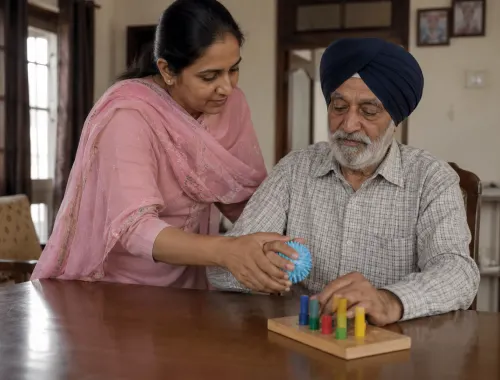
Recovery Support After Stroke at Home
Stroke recovery does not end when a patient returns home; in many ways, that is when the family’s most important role begins.
After a stroke, a survivor may face weakness, stiffness, speech difficulty, tiredness, emotional changes, memory concerns, or loss of confidence. Families often want to help, but they may not know what kind of support is useful, what should be avoided, or how long recovery may take.
For families in the Ladda-SSV village network, recovery support is part of a wider rural community stroke care pathway. Ladda-Stroke Safe Village, also known as Ladda-SSV, supports stroke survivors through appointment-based rehabilitation, tele-rehabilitation, and practical family guidance rooted in village life.
Why home support matters after stroke
A stroke can affect movement, speech, swallowing, memory, mood, and independence. Some people recover quickly in certain areas, while others need longer support. No two stroke survivors recover in exactly the same way.
Home support matters because the survivor spends most of their time with family. The daily environment can either encourage safe progress or create confusion, frustration, and unnecessary dependence.
Good family support does not mean doing everything for the survivor. It means helping the person practise safely, follow professional guidance, maintain dignity, and stay connected to normal life as much as possible.
Recovery needs patience and structure
Many families expect recovery to happen in a straight line. In reality, progress may be slow and uneven. A survivor may improve in one skill while still struggling with another. Some days may be better than others.
This can be emotionally difficult for both the patient and the caregiver. A structured routine helps. Regular practice, rest, meals, medicine, appointments, and family encouragement can give the survivor a sense of stability.
Families should avoid comparing one stroke survivor with another. Recovery depends on many factors, including the type of stroke, severity, age, other medical conditions, timing of treatment, rehabilitation access, and continued practice.
The role of guided rehabilitation
Rehabilitation helps the brain and body relearn skills after stroke. It may focus on movement, balance, hand function, walking, speech, daily activities, or confidence in using the affected side.
Ladda-SSV supports stroke rehabilitation through Mata Rupinder Clinic and tele-rehabilitation. The rehabilitation service is appointment-based and limited to registered stroke patients. It is not a general walk-in neuro-rehabilitation centre for every condition.
Available rehabilitation methods may include neuroplasticity-based rehabilitation, mirror therapy, soft robotic glove-based therapy, TENS, and guided tele-rehabilitation. These approaches are used according to the patient’s needs and the team’s assessment.
The goal is not to promise a fixed result. The goal is to provide structured, guided support that helps survivors work toward better function and quality of life.
What families can do at home
Family members can make recovery easier by creating a safe and supportive home routine. This may include keeping walking areas clear, helping the survivor sit properly, encouraging safe movement, and supporting practice recommended by the rehabilitation team.
Caregivers should also help the survivor stay involved in daily life where possible. Simple tasks, conversation, decision-making, and social connection can protect dignity and motivation.
It is important not to force difficult exercises without guidance. Wrong practice, unsafe transfers, or overexertion can cause harm. Families should follow the plan given by the rehabilitation team and ask for clarification when unsure.
Encouragement should protect dignity
Stroke survivors may feel embarrassed, dependent, or frustrated. Some may become quiet. Others may become emotional or impatient. Families should remember that recovery is not only physical. It is also emotional and social.
Encouragement works best when it is respectful. Speak to the survivor as an adult. Avoid blaming, scolding, or treating them like a burden. Celebrate small improvements, but do not pressure the person with unrealistic expectations.
A calm family environment can help the survivor feel safer and more willing to participate in recovery.
Caregivers also need support
Caregiving after stroke can be tiring. A caregiver may have to manage medicines, appointments, mobility support, meals, hygiene, sleep changes, and emotional stress. In many homes, one person carries most of this responsibility.
Families should try to share duties where possible. Even small support from relatives or neighbours can reduce caregiver strain. A caregiver who is exhausted may struggle to provide safe and patient support.
Caregivers should also ask questions during rehabilitation appointments. Understanding the recovery plan can reduce fear and confusion at home.
Tele-rehabilitation can improve continuity
For village families, travel can become a major barrier to regular rehabilitation. Distance, transport, time, cost, and caregiver availability may all affect follow-up.
Tele-rehabilitation helps continue guided support through video-based sessions where appropriate. Ladda-SSV provides daily tele-rehabilitation support for registered stroke patients as part of its rural care pathway. The tele-rehabilitation system is available for upper-limb rehabilitation, while further development continues for lower-limb components.
This kind of support can help families stay connected with the rehabilitation process even when regular travel is difficult.
Recovery should stay connected to prevention
After one stroke, prevention becomes especially important. Families should support regular medical follow-up, medicine adherence, blood pressure control, blood sugar awareness, diet guidance, and doctor-advised lifestyle changes.
Rehabilitation and prevention work together. A survivor may improve movement, but long-term safety also depends on reducing future risk. This is why Ladda-SSV treats stroke care as a connected pathway, not a single event.
The same family that supports exercises at home can also support medicine routines, health checks, and timely follow-up.
When families should seek help
Families should seek urgent medical help if a stroke survivor develops new sudden weakness, speech difficulty, facial drooping, confusion, severe headache, loss of balance, chest pain, breathing difficulty, or any serious sudden change.
New symptoms should not be treated as a normal part of recovery without guidance. Stroke can recur, and other medical problems can also develop after discharge.
For acute suspected stroke concerns within the Ladda-SSV village network, families should begin with the helpline pathway. For planned rehabilitation, families should follow the appointment process for registered stroke patients.
Recovery is a community responsibility
A stroke survivor should not feel forgotten after leaving hospital. Recovery often takes time, care, repetition, and understanding. Families, neighbours, volunteers, and village institutions can all help create a more supportive environment.
Ladda-SSV was created to make villages safer not only during a stroke emergency, but also before and after it. Through prevention, acute care support, rehabilitation, and tele-rehabilitation, the model aims to bring structure to a journey that many rural families have faced alone.
For stroke survivors and caregivers in the Ladda-SSV village network, TheBrownMove Foundation, Ladda offers a community-rooted pathway for planned recovery support. Connect with the Ladda-SSV team to understand appointment-based rehabilitation and tele-rehabilitation options for registered stroke patients.