Academic Guidance
Academic Guidance for a Rural Stroke-Safety Model
Ladda-SSV is guided by senior stroke mentorship, clinical oversight, and responsible academic supervision. This guidance helps the model stay focused, careful, and appropriate for rural community stroke care.
1
Senior Mentorship
Experienced stroke leadership helps shape the model’s direction.
2
Clinical Oversight
Clinical guidance supports safe boundaries and careful public messaging.
3
Responsible Learning
Service work and research activity remain clearly separated.
Why It Matters
Why Guidance Matters in Rural Stroke Care
Rural stroke care needs more than awareness. It needs clear recognition, careful response pathways, prevention support, rehabilitation planning, and honest learning from practice.
Clear Care Boundaries
Academic and clinical guidance helps define what Ladda-SSV can safely support, what belongs to hospital care, and what should not be overclaimed.
Structured Rural Response
Guidance supports a village-level pathway that connects recognition, helpline-based assessment, prevention, and rehabilitation in a careful way.
Responsible Public Learning
The model is designed to learn responsibly from rural stroke work while keeping community services and research activity distinct.
Mentorship and Oversight
Senior Mentorship and Clinical Oversight
Ladda-SSV is supported by experienced stroke leadership and clinical guidance. These roles strengthen the seriousness, structure, and safety of the model without changing its identity as an initiative of TheBrownMove Foundation, Ladda.
Prof. Jeyaraj Pandian
Senior Mentor
Principal, CMC Ludhiana, and President, World Stroke Organization. His mentorship supports the academic and stroke-systems direction of Ladda-SSV.
Dr. Ivy Sebastian
Clinical Lead
Associate Professor, Neurology, CMC Ludhiana, and Clinical Principal Investigator of the research arm. Her role supports clinical oversight and responsible academic direction.
Responsible Learning
Academic Supervision for Responsible Learning
The service arm and the research arm are related, but they are not the same. Community services are designed to support the Ladda-SSV village network, while research activity must follow the required academic and ethics processes.
This distinction protects the public, the foundation, and the credibility of the work.
Community Service Work
Practical support delivered through the Ladda-SSV pathway, including awareness, prevention checks, eligible stroke transport support, and appointment-based rehabilitation services.
Research Activity
A separate academic layer under supervision, intended to study and learn from the model only through the appropriate approval and governance process.
Evidence-Minded Work
A Careful, Evidence-Minded Approach
Ladda-SSV should be understood as a serious rural stroke care pilot with structured design and academic direction. It should not be presented as a proven or published outcome model before approved evidence is available.
Structured
The model follows a planned approach to village-level stroke recognition, response, prevention, and rehabilitation.
Careful
Public claims should remain accurate, especially around research status, hospital care, and clinical outcomes.
Learning-Oriented
The research direction supports responsible learning without confusing service delivery with published proof.
Model Support
How Guidance Supports Ladda-SSV
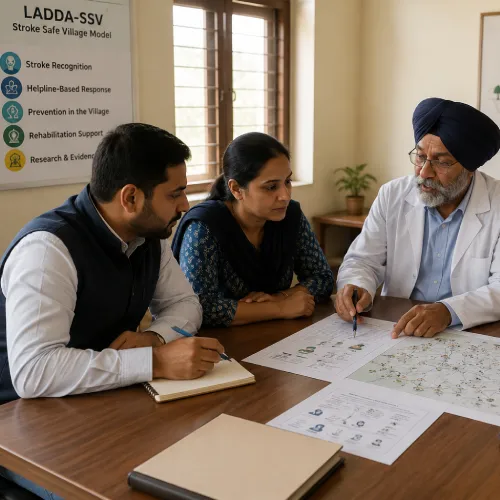
Academic and clinical guidance helps keep the model focused on rural stroke care, public safety, and responsible communication.
1
Safer Public Messaging
Guidance helps the foundation explain stroke recognition and service boundaries without giving unsafe or exaggerated claims.
2
Clear Response Pathways
The model can explain urgent stroke support as helpline-based and stroke-specific, not as a general emergency service.
3
Focused Prevention Work
Prevention messaging can stay practical, community-rooted, and aligned with the model’s village network approach.
4
Responsible Rehabilitation Context
Rehabilitation can be presented as appointment-based stroke support without making broad claims about every neurological condition.
5
Research Separation
The academic layer keeps research activity separate from community service delivery and protects the integrity of both.
Questions
Academic Guidance FAQs
These answers clarify the guidance relationship, the research boundary, and the careful language used around Ladda-SSV.
Is Ladda-SSV run by CMC Ludhiana?
Ladda-SSV is an initiative of TheBrownMove Foundation, Ladda. The model is supported through mentorship, clinical oversight, guidance, and academic supervision where applicable, but it should not be described as owned or operated by CMC Ludhiana unless that wording is formally approved.
Who provides academic and clinical guidance?
Prof. Jeyaraj Pandian serves as Senior Mentor, and Dr. Ivy Sebastian serves as Clinical Lead. Dr. Ivy Sebastian is also the Clinical Principal Investigator of the research arm.
Is the research arm the same as the community service work?
No. The community service arm and the research arm are related, but they are distinct. Services support the village network, while research activity must follow academic supervision and required approval processes.
Does Ladda-SSV already have published outcome results?
Ladda-SSV should be described as structured, evidence-minded, and research-oriented. Submitted research work should not be presented as published outcome proof unless approved published evidence is available.
Where can academic visitors learn more?
Academic visitors can continue to the Research Arm and Studies & Evidence pages, or use the Contact page for appropriate enquiries.
Research Direction
Learn More About the Research Direction
Explore how the research arm, studies, and academic guidance support the responsible development of Ladda-SSV.